Looking for McDonald’s allergens Canada information before you order? This guide shows which allergens McDonald’s Canada tracks, where the official item details live, and what the kitchen warning really means.
We do not copy an allergen table from another website. A table is only safe when it comes from McDonald’s Canada itself, in its current version. Recipes and suppliers change, and a copied table goes stale without any warning.
You can also browse the full McDonald’s Canada menu prices to plan your order once you know what is safe for you to eat.
Quick Answers
Which allergens does McDonald’s Canada track?
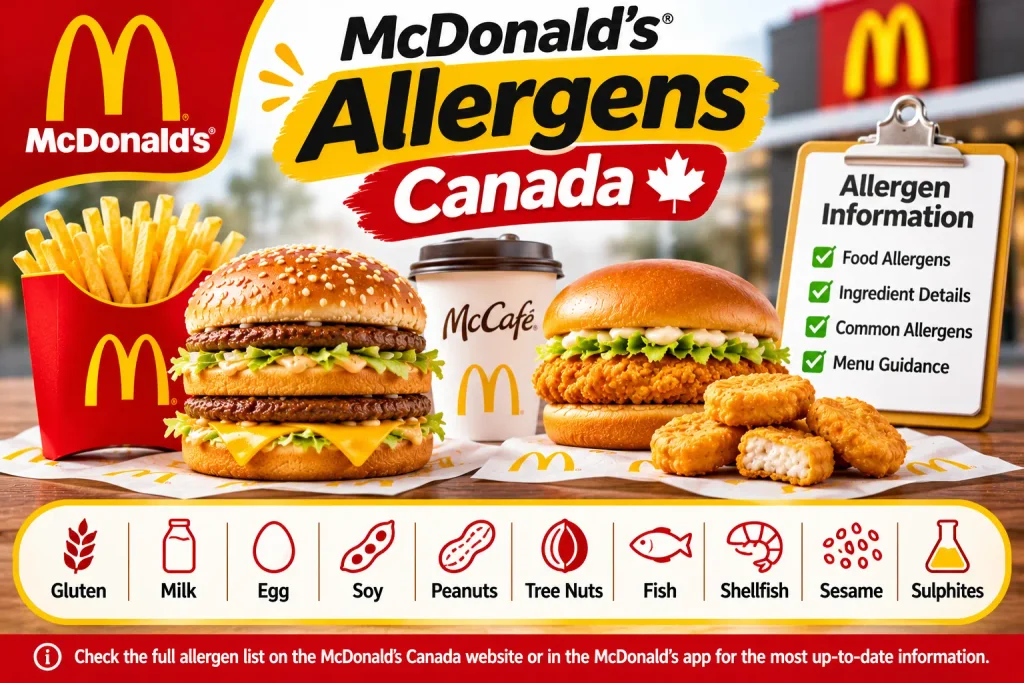
Ten priority allergens identified by Health Canada: eggs, milk, mustard, peanuts, seafood, sulphites, sesame, soy, tree nuts, and wheat and other cereal grains containing gluten. Seafood covers fish, crustaceans, and shellfish.
Where is the official allergen information?
On the McDonald’s Canada website and in the McDonald’s app. Open an item and its ingredient and allergen details appear on that page. The official Nutrition Calculator is a good starting point.
Can McDonald’s guarantee an item is allergen-free?
No. McDonald’s Canada says normal kitchen operations involve shared storage, cooking and preparation areas, equipment, utensils, and displays. Food can come into contact with other allergens.
Who can I contact with a question?
The McDonald’s Guest Relations Contact Centre at 1-888-424-4622.
The 10 Priority Allergens in Canada
Health Canada names ten priority food allergens. These are the allergens McDonald’s Canada publishes ingredient information for.
This is not the same as the US list that most websites copy. Canada tracks mustard and sulfites as priority allergens in their own right.
- Eggs: common in sauces and baked items, so they can hide where the name does not suggest them.
- Milk: cheese and butter are obvious, but milk ingredients also appear in coatings, sauces and desserts.
- Mustard: found in some sauces and dressings.
- Peanuts: an ingredient in some desserts and toppings, and the allergen behind the strictest warnings.
- Seafood: fish, crustaceans, and shellfish, tracked as one group.
- Sulphites: preservatives used in some processed ingredients and drinks.
- Sesame: seeds and sesame oil, which can appear in buns and bagels.
- Soy: widespread in processed food, including cooking oils.
- Tree nuts: almonds, walnuts, cashews, and others, listed separately from peanuts.
- Wheat and other cereal grains containing gluten: the group behind every bun, breading, and batter question.
This list tells you what to look for. It does not tell you what is inside a specific item. For that, open the item page and read it.
How McDonald’s Canada Publishes Allergen Information
McDonald’s Canada does not publish one downloadable allergen chart that a third-party site could verify. The information is published item by item, in places McDonald’s controls.
- The website. Each menu item page carries its ingredient and allergen details.
- The app. This is the best version to check while you are ordering.
- The restaurant. Tell the crew about your allergy before you order.
- Guest Relations. Call 1-888-424-4622 for anything unclear.
Two limits are worth knowing. The information covers menu items sold in Canadian restaurants only, and some items are not available everywhere.
Test products, regional products, and limited-time items may not be included at all. Check those the most carefully.
The Cross-Contact Warning
This is the most important section on the page, and it comes from McDonald’s Canada itself.
Despite precautions, shared storage, cooking and preparation areas, equipment, utensils and displays mean your food may come into contact with other food products, including other allergens.
An item whose ingredient list does not name your allergen can still have touched it in a working kitchen. That is why McDonald’s Canada does not certify any item as allergen-free.
The ingredient list tells you what is in the recipe. The warning tells you what a kitchen is. For a severe allergy, the warning is the half that decides.
McDonald’s Canada also notes that product formulations change periodically. Some variation between published information and the item you receive is expected.
What to Check Across the Menu
Allergens tend to hide in certain parts of a menu. These are the places worth a closer look on each item page.
- Buns, wraps and bagels: check for wheat, gluten, sesame, and milk.
- Breaded and battered items: check for wheat, egg, milk, and soy.
- Sauces and dressings: check for mustard, egg, soy, and sulphites. The same goes for the sandwiches on the breakfast menu, which often add egg and cheese.
- Desserts and shakes: check for milk, egg, soy, peanuts, and tree nuts, especially in McFlurry mix-ins and limited-time toppings.
- Drinks: check for milk, soy, sulfites, and flavored syrups.
- Kids meals: the Happy Meal mixes items from several categories, so check every part of the meal, not just the main.
This is a guide to where to look. It is not a list of what is safe.
Why This Page Has No Allergen Table
Most allergen pages on menu price websites show a grid with ticks and crosses. For Canada, those grids are risky for three reasons.
- They are often US tables. The US tracks nine major allergens, and recipes differ by country. The same item name can hide a different formulation.
- They go stale. McDonald’s Canada updates its item information when a recipe or supplier changes. A copied grid does not.
- A wrong cell costs more than a wrong price. A stale price costs a dollar. A stale allergen claim can put someone in the hospital.
So this page does the honest version. It gives you the Canadian allergen list, shows you where the official information lives, and prints the cross-contact warning in full.
Ordering With an Allergy: A Careful Routine
Nothing here is medical advice, and no website can tell you what is safe for you. This routine follows what McDonald’s Canada’s own information supports.
- Check before you go. Read the item’s ingredient and allergen information while you have time.
- Recheck every visit. Formulations change, so an old screenshot is not a check.
- Say it out loud. Tell the crew it is an allergy, not a preference.
- Treat limited time items as unknown. They may sit outside the standard published set.
- Call Guest Relations if unsure. The number is 1-888-424-4622.
- Talk to your doctor. McDonald’s Canada advises guests with allergies or special dietary needs to consult a doctor about their diet.
For calorie and nutrient details alongside allergens, see our McDonald’s Canada nutrition guide.
Canada Is Not the US Menu
Allergen answers written for the United States do not transfer to Canada. The allergen lists differ, and each country’s menu is formulated and supplied separately. An answer that is right for a US restaurant can be wrong at a Canadian one with the same item name.
If you read an allergen answer on another site, check which country it was written for. If it does not say, treat that silence as your answer.
FAQs
What are the top 10 allergens in Canada?
Health Canada’s priority allergens are eggs, milk, mustard, peanuts, seafood, sesame, soy, sulphites, tree nuts, and wheat and other gluten-containing cereal grains. Seafood includes fish, crustaceans, and shellfish. McDonald’s Canada works to this same list when it publishes ingredient information.
What allergens are on the McDonald’s Canada menu?
Any of the ten priority allergens can appear, depending on the item. Which ones apply to a specific burger, dessert, or drink is shown on that item’s page on the McDonald’s Canada website or app. Always read the current page before ordering.
Is McDonald’s Canada safe for peanut allergies?
No website can answer that for you. McDonald’s Canada warns that shared equipment and preparation areas can cause contact with other allergens. Check each item’s page, tell the crew about the allergy, and ask your doctor what is right for you.
Does McDonald’s have an allergy menu?
We have not found a separate allergy menu that can be verified. McDonald’s Canada publishes allergen and ingredient information item by item on its website and in its app. Use those pages and confirm with the restaurant.
Are McDonald’s fries gluten-free in 2026?
We cannot confirm that, and we will not guess. Check the fries item page on McDonald’s Canada’s website or app for current information. Remember the cross-contact warning, since fried items are cooked in a vegetable oil blend in a working kitchen.
Is anything at McDonald’s gluten-free?
Some items may not list gluten-containing ingredients, but McDonald’s Canada does not guarantee any item is free of allergens. Check each item page. People with celiac disease should consult their doctor, as McDonald’s itself advises.
Can celiacs eat anything at McDonald’s?
That is a decision for you and your doctor. Published ingredient information shows the recipe only. Shared storage, cooking and preparation areas mean gluten contact is still possible, so the risk depends on how sensitive you are.
Does McDonald’s offer any gluten-free products?
McDonald’s Canada does not market a certified gluten-free range that we can verify. Individual items may not contain gluten ingredients, so read each item page and recheck regularly because formulations change.
Are McDonald’s hash browns gluten-free and vegan?
Check the hash browns item page for current ingredients. On vegan, McDonald’s Canada states that no products are certified vegetarian and that items may contain trace amounts of animal-derived ingredients. That means a vegan claim should not be assumed.
Do McDonald’s burger patties have gluten?
Check the item page for the current recipe. For burgers, gluten more often comes from the bun, sauces, and toppings than from the patty itself, but only the official ingredient information can confirm it for the item you want.
Final Thoughts
The safest source for McDonald’s allergens Canada details is McDonald’s Canada itself. Check the item page before every order, read the cross-contact warning, and speak up in the restaurant.
If you are choosing a treat for someone with a food allergy, look at the McFlurry and dessert menu with extra care, since toppings and mix-ins change often.